






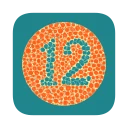
Color Blind Test with Ishihara Dot Plates
This color blind test screens for color vision deficiencies using Ishihara-style dot plates, where a hidden number is woven into a field of colored dots. People with normal color vision read the number easily, while those with a color deficiency may see something different or nothing at all.
Color vision deficiency affects roughly 8% of males and 0.5% of females, and many people never realize it until they take a test. This screening runs 10 plates, then breaks your answers down into red-green and blue-yellow categories so you can see where, if anywhere, you struggled.
How to Use the Color Blindness Test
Set up your screen
Sit about 75 cm (30 inches) from the display, set a comfortable brightness, and avoid glare or direct sunlight. Turn off night mode and blue-light filters, and remove any tinted glasses.
View each dot plate
Press Start Test and look at the circle of colored dots. Try to read the single-digit number hidden inside before answering.
Select the number you see
Tap the matching digit on the 0-9 numpad, or choose "I can't see a number" if none is visible to you. The test advances to the next plate automatically.
Read your results
After all 10 plates you get a total score plus separate red-green and blue-yellow scores, a per-plate breakdown, and a plain-language explanation. Use Previous any time to revisit an earlier plate, or Retake Test to start fresh.
Features
10 Ishihara-Style Plates
Ten dot plates, each with a single-digit number hidden through hue contrast: one demonstration plate plus nine screening plates.
Red-Green Screening
Seven plates target the protan-deutan range to check how well you distinguish red, orange, and green hues.
Blue-Yellow Screening
Two plates target the tritan range to check how well you tell blue from yellow hues.
Numpad Answers with Auto-Advance
Pick the number you see on a 0-9 grid, or flag "I can't see a number." The test jumps to the next plate on its own.
Score Breakdown by Type
Results show a total score plus separate red-green and blue-yellow scores and a colored dot for each plate you answered.
Result Explanations & Severity
Each classification comes with a clear explanation, and detected deficiencies are graded mild, moderate, or strong.
Previous Navigation & Retake
Step back to review or change an earlier answer, or retake the test with freshly regenerated dot patterns.
Runs Entirely in Your Browser
Plates are rendered and scored locally on your device, so nothing is uploaded and no data is collected.
Frequently Asked Questions
How does the Ishihara color blind test work?
Each plate packs colored dots into a circle, with a number formed by dots in a contrasting hue. If your color vision is normal, the number stands out clearly. If you have a deficiency in that color range, the number blends into the background and becomes hard or impossible to read.
How many Ishihara plates are in this test?
There are 10 plates: 1 demonstration plate that everyone should be able to read, 7 red-green (protan-deutan) screening plates, and 2 blue-yellow (tritan) screening plates.
Is this online color blind test accurate?
It is a screening tool based on the Ishihara method, not a clinical diagnosis. Screen brightness, color calibration, and lighting can all affect the results. If the test suggests a deficiency, see an eye care professional for a full evaluation.
What are the types of color blindness?
The most common is red-green deficiency, which includes protanopia (reduced red sensitivity) and deuteranopia (reduced green sensitivity) and affects about 8% of males. Blue-yellow deficiency (tritanopia) is rare, affecting less than 0.01% of people, who have trouble distinguishing blue from yellow.
Why can I see the number on the first plate but not others?
The first plate is a demonstration plate designed to be visible to everyone, including people with color deficiencies. It confirms you understand the format. The remaining plates use specific color pairings that disappear for people with particular types of color vision deficiency.
Does my screen affect the results?
Yes. Brightness, color temperature, and display quality all change how the plates look. For the most reliable reading, use a well-calibrated monitor at a comfortable brightness, turn off night mode and blue-light filters, and avoid glare or direct sunlight.
Can a color blind test diagnose me officially?
No. This screening cannot replace an official medical diagnosis, and its results are not valid for driving, employment, or other formal requirements. Use it to spot a possible issue, then confirm with a qualified eye care professional.
Can I retake the test?
Yes. Choose Retake Test on the results screen to return to the start. Each run regenerates the dot patterns with fresh random placement while keeping the same colors and hidden numbers.






No comments yet. Be the first to comment!